
The Fascinating World of Markov Chains: From Drunkard’s Walks to Google’s Algorithms
Imagine a drunk man stumbling down a street. At each step, he can either move one step forward or one step back, with equal probability. He doesn't remember where he came from-he only knows where he is right now. This simple, quirky scenario is actually one of the most famous illustrations of a Markov chain.
By the BayanWin team · Published · Updated
A Story Rooted in History
In 1906, Russian mathematician Andrey Markov challenged the idea that randomness always required independence. He showed that even when events depend on the immediate past, powerful mathematical laws still hold. To prove it, he analyzed the distribution of vowels and consonants in Pushkin's Eugene Onegin. Yes, poetry helped launch one of the most important concepts in probability theory.
What Makes a Markov Chain Special?
At its heart, a Markov chain is about memorylessness:
- The future depends only on the present.
- The past doesn't matter once you know the current state.
Think of it like playing a board game where the dice roll determines your next move. It doesn't matter how you got to your current square-only where you are now.
Real-World Adventures of Markov Chains
- Card Shuffling: Henri Poincare studied them to understand how many shuffles it takes before a deck of cards is random enough.
- Economics & Finance: Stock market fluctuations often rely on Markov models to predict trends.
- Speech Recognition: Your phone's voice assistant uses hidden Markov models to guess what word you're saying.
- Google's PageRank: The algorithm that made Google famous is essentially a giant Markov chain, deciding which websites you're most likely to walk to next.
Fun Examples You Can Picture
- The Drunkard's Walk: Each step is random, but over time, patterns emerge.
- Gambler's Ruin: A casino player keeps betting until they either win big or lose everything. The probabilities of ruin can be modeled with Markov chains.
- Mark V. Shaney: A quirky text generator from the 1980s that stitched together Usenet posts using Markov chains, producing hilarious nonsense sentences.
Why Should You Care?
Markov chains are the backbone of simulation, prediction, and AI. From weather forecasting to DNA sequencing, they help us make sense of uncertainty. They show us that even in randomness, there's structure-and that structure can be harnessed to solve real problems.
How BayanWin uses it
In BayanWin, the Markov-style model is one member of a six-model ensemble that also includes XGBoost, Decision Tree, NashHotFilter, Deep Reinforcement Learning, and the Miro LLM synthesis layer. For PCSO lottery games (6/42, 6/45, 6/49, 6/55, and 6/58), the model builds a transition matrix from years of draw history and identifies which numbers tend to follow which sequences. Because lottery draws are statistically independent events, the model does not claim causal power — instead it surfaces sequence patterns in the historical record that you can compare against other model outputs.
We surface all model outputs simultaneously in the Council Panel, so you can see where the Markov model agrees with tree-based or frequency-driven models (potentially higher-confidence signals for exploration) and where it diverges (a reminder to be cautious). This multi-model approach is more transparent than relying on a single black-box algorithm.
Markov chains and Philippine lottery analysis
The Philippines Charity Sweepstakes Office (PCSO) has been running six-ball lottery draws for decades, which means there are thousands of historical results available for analysis. This depth of data is what makes transition-based models like Markov chains meaningful: with only a few dozen results, transition estimates are noisy; with thousands, the statistical regularities become clearer (while still not predictive of any individual future draw).
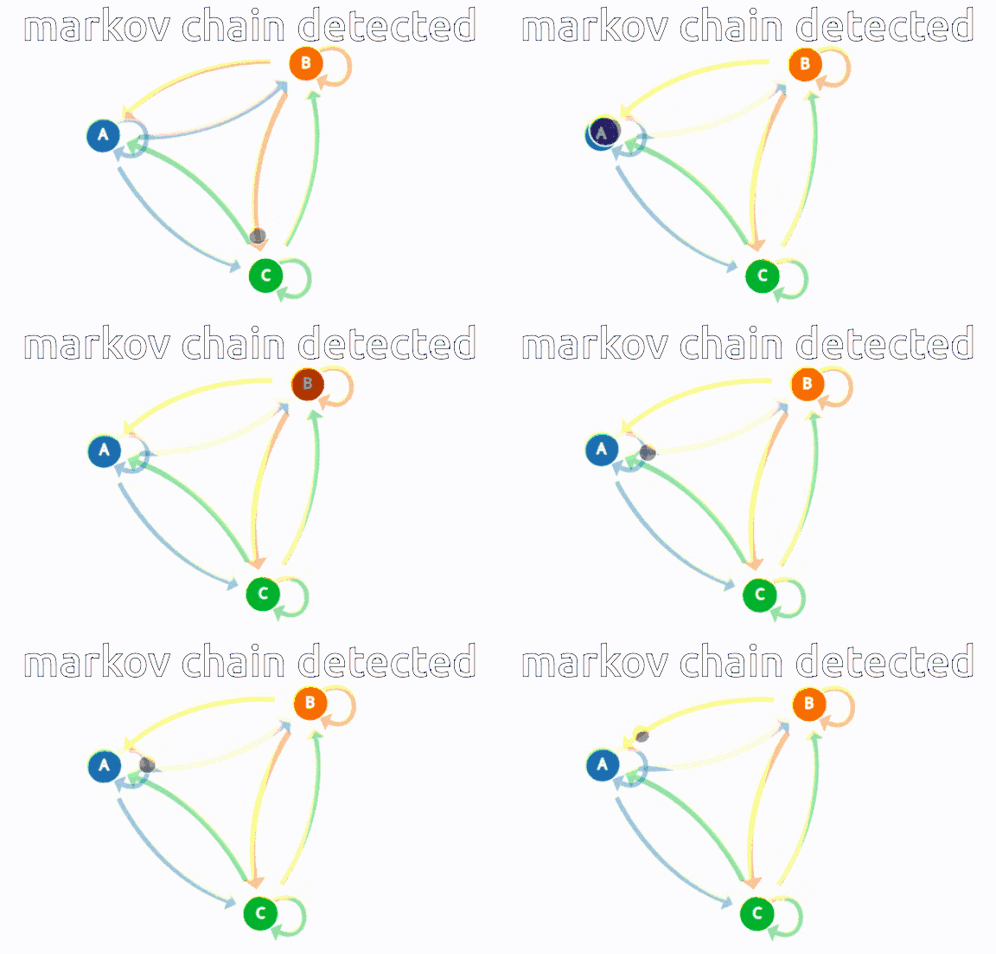
For each PCSO game, BayanWin maintains a separate transition model calibrated to that game's number pool size. The 6/42 pool behaves differently from the 6/58 pool purely because of the number of possible outcomes — and the Markov model's transition matrix reflects those differences in the historical record. Users can view the Markov graph visualization directly in the dashboard after selecting any game.
An important practical limitation: PCSO lottery balls are drawn without replacement within each game, making the process a sampling event rather than a simple state-transition process. The Markov abstraction used here treats the drawn combination as a "state" for modelling purposes — a useful simplification for pattern exploration, not a strict mathematical match to the physical draw process.
Deeper concepts: stationary distributions and mixing times
Beyond simple transition probabilities, two concepts matter for anyone wanting to go deeper into Markov chain theory:
- Stationary distribution — over many steps, a Markov chain often converges to a stable probability distribution across its states, regardless of the starting point. For a truly random lottery, this stationary distribution is uniform (every number equally likely). Comparing observed long-run frequencies to this uniform baseline is exactly the kind of analysis BayanWin's frequency charts provide.
- Mixing time — how many steps it takes for the chain to get close to its stationary distribution. A chain with fast mixing (like a well-shuffled lottery) "forgets" its starting state quickly. This is one reason why short-term historical windows can look patterned even in genuinely random data.
These concepts explain why Markov models are genuinely useful for understanding lottery history without implying they can predict the future. They describe how the system has behaved, not how it will behave next.
FAQ: Markov chains and lottery prediction
Can a Markov chain predict the next PCSO lottery draw?
No. PCSO draws use certified random mechanisms where each draw is independent of previous results. A Markov chain model can describe historical sequence patterns, but it cannot predict a genuinely random outcome. BayanWin's Markov output is an exploratory tool for studying historical behaviour, not a forecasting system.
Why is the Markov model one of several in BayanWin rather than the only one?
Because no single model captures every aspect of a complex historical dataset. XGBoost captures non-linear tabular relationships; frequency models show raw appearance rates; NashHotFilter incorporates balance heuristics; Deep RL adapts to feedback over time. Each model reflects a different set of assumptions, and comparing their outputs is more informative than trusting any one of them alone.
Is the drunkard's walk a good mental model for lottery draws?
Partially. The drunkard's walk illustrates memorylessness (each step is independent of prior path), which is a valid analogy for lottery draws. However, the walk is on a continuous line while a lottery draw selects from a fixed pool of numbers without replacement — so the analogy is useful for intuition but should not be taken literally when interpreting model outputs.
How do I view the Markov analysis for a specific PCSO game on BayanWin?
Go to the homepage, select a game (e.g. 6/49 or 6/58), then scroll down to the Markov Graph visualisation. The graph shows transition relationships between number groups based on the loaded historical window. You can also generate algorithmic predictions to see the Markov model's candidate output alongside all other models.
Where can I learn more about the mathematical theory behind Markov chains?
Standard university probability and stochastic processes textbooks cover Markov chains in depth. Online resources from MIT OpenCourseWare (18.650 Statistics for Applications) and similar courses provide accessible introductions. Andrey Markov's original 1906 paper on dependent trials in sequences is also available in translation for the historically curious.
For broader context, read About BayanWin and our Responsible Play guidance.